
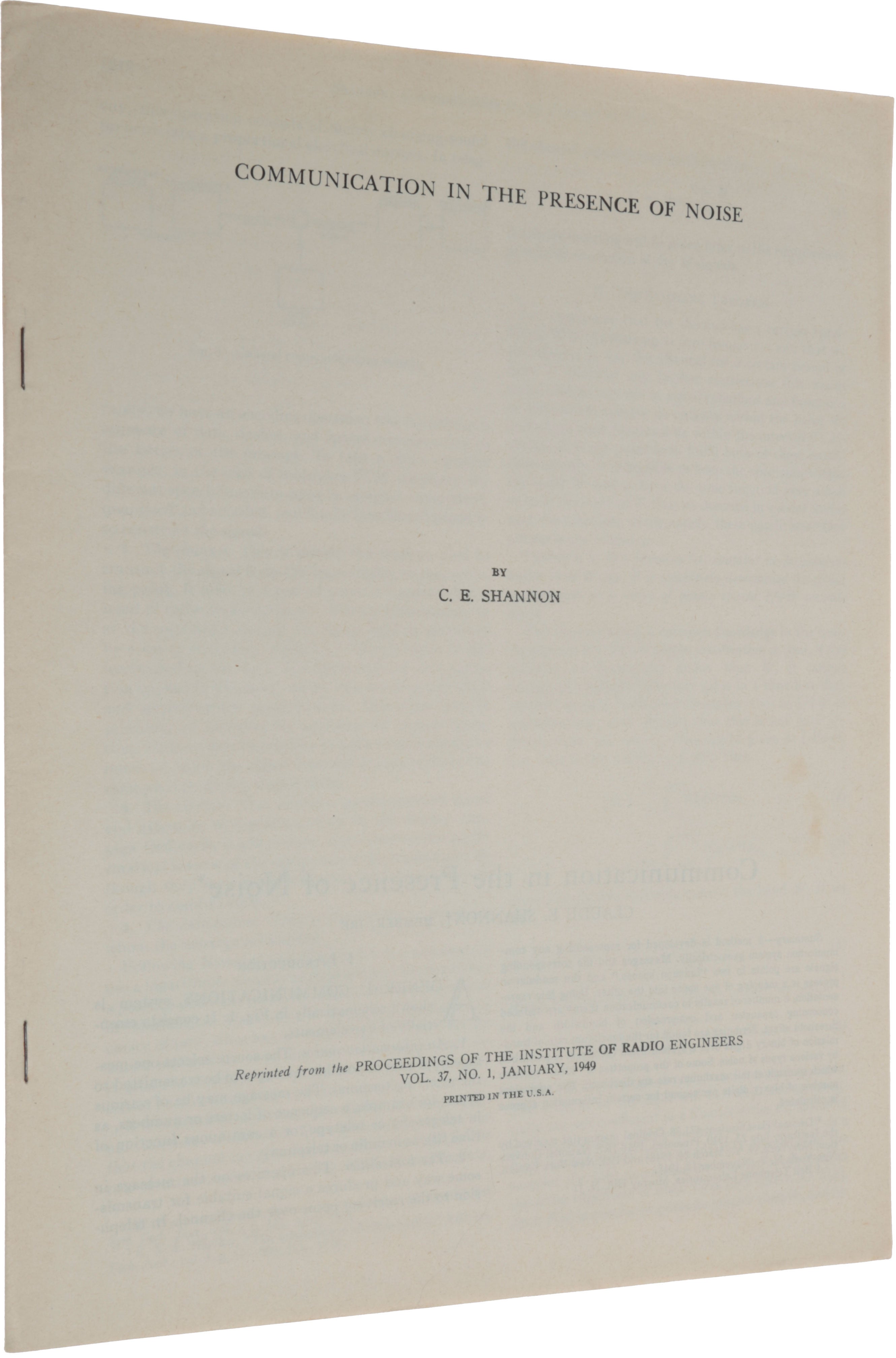


Communication in the Presence of Noise.
[New York: The Institute of Radio Engineers, Inc.], 1949. First edition of the rare author’s offprint, from Claude E. Shannon’s personal files, of the paper that first put into print three of the results on which modern communication rests: the geometric proof of the channel-capacity formula C = W log2(1 + S/N), the water-pouring solution for channels whose noise varies across the band, and the sketch of what became rate-distortion theory. These are not historical landmarks but working tools — the mathematics of how much information a noisy channel can carry, and of how to load it, that runs in the deep-space telemetry codes of the 1960s, in every telephone modem and DSL line, and in the OFDM and massive-MIMO systems of 5G. The copy offered here is the author’s own, an offprint Shannon kept in his working files. The heart of the paper is a picture. Shannon represents a signal limited to bandwidth W and duration T as a single point in a space of 2WT dimensions, its coordinates the values of the signal read off at intervals of 1/2W seconds; a message is then a point, transmission displaces that point by a noise vector, and reception is the problem of deciding which point was sent. For Gaussian noise the received point falls, with near-certainty, on a thin spherical shell about the transmitted one, so that the number of messages that can be told apart is simply the number of such noise-spheres that pack into the larger sphere of all possible received signals. Counting them yields the capacity. The conclusion — which Shannon himself called ‘a rather surprising result’ — ran flatly against the engineering intuition of 1949, which held that forcing the error rate down must cost transmission rate: Shannon’s geometry shows instead that any rate below the capacity can be achieved with as few errors as one likes, provided the codes are made long enough — the channel-coding theorem, stated in prose, that the next half-century of coding theory set out to make real. The reformulation was what made the theory usable. Shannon had founded information theory the year before, but by arguments abstract enough that few practising communication engineers could follow or apply them; here the same capacity is reached by a geometric argument an engineer can see — what John Pierce, his colleague at Bell Labs, called ‘a clear and appealing geometrical derivation’ — and the picture of messages as points and codes as sphere-packings became the working language of the field. The capacity it defined set a target approached only slowly: for four decades real systems ran several decibels short of the Shannon limit, and then, in the space of a few years, all but closed the gap. The turbo codes Berrou and Glavieux announced in 1993 came within half a decibel of it; the low-density parity-check codes that followed were brought to within 0.0045 of a decibel by 2001; and the polar codes Erdal Arıkan introduced in 2009 became the first proved to reach the bound outright — codes that, with the turbo codes before them, now run the data and control channels of every 4G and 5G handset. A result that can still be named as the target half a century after it is proved is rare in any science. Stated here too, as the paper’s Theorem 1, is the result now taught in every signals course as the sampling theorem: a signal containing no frequency higher than W is completely determined by its values taken 1/2W seconds apart. It is the theorem that lets the continuous world enter the discrete one without loss — the principle beneath digital audio, digital imaging, and every analog-to-digital converter built since. The two remaining results extend the theory’s reach. The water-pouring theorem solves the channel whose noise is uneven across the band by allocating transmitter power the way water finds its level against an uneven floor, filling the quietest sub-bands first; it is the analytical foundation of every multi-carrier system, from the OFDM of digital broadcasting and Wi-Fi to the sub-carriers of DSL and 5G. The closing sections sketch the rate-distortion problem — how few bits suffice to reconstruct a source to a prescribed fidelity — which Shannon would work out fully a decade later and which now governs every lossy codec, every compressed image, every digital call. That all of this is still the working mathematics of communication, three-quarters of a century on, is the measure of the paper. The copy offered here comes from Shannon’s own files, and that is its distinction. After his death in 2001 the family papers remained with his widow, Mary Elizabeth (‘Betty’) Moore Shannon — herself a Bell Labs computer who had looked up his references and taken down and edited his work, his early papers sometimes surviving in her handwriting rather than his — at the house on Upper Mystic Lake in Winchester, Massachusetts that the family called Entropy House; after her death in 2017 the surviving children placed the holdings — some eighty items Shannon had written or co-authored, kept together as his working library — with a single specialist dealer. The present offprint is one of those file copies, unmarked, as Shannon left it. The family’s identification of the channel is itself on record: Shannon’s son Andrew confirmed in writing the family ownership of another item from the same cache, anchoring the provenance of the whole. Offprints of the paper from Shannon’s own files are scarce, and the present copy carries that association directly. A few copies survive through other hands — one signed on the wrapper by a contemporary MIT communications engineer, others through the general rare-book trade — but none with the author’s-working-files provenance, and the offprint is not separately recorded in the union library catalogues. The paper falls after the effective cutoff of the older science canons; the standard collector reference for it is Hook & Norman, Origins of Cyberspace, where it is number 882, and the IEEE marked it a Classic Paper, reprinting it in full — with an introduction by Aaron Wyner and Shlomo Shamai — in the Proceedings of the IEEE in 1998. What the paper accomplished was to carry information theory across the line from mathematics into engineering. When Robert Gallager — Shannon’s student and his successor at MIT — published Information Theory and Reliable Communication in 1968, the book from which two generations of engineers learned the subject, he was systematising what Shannon had first drawn here in pictures. Information theory reached the engineers through this paper; the channels they have built ever since, from the telephone modem to the mobile call to the link with a spacecraft beyond the planets, run on the capacity it taught them how to count. 4to (283 × 217 mm), pp. [1], [10], 11–21, [1, blank]. Self-wrappers in buff stock, stapled at spine, with the running journal pagination of Proceedings of the IRE volume 37 preserved across pp. 10–21. Near fine.
Item #5549
Price: $8,500.00
