
A Symbolic Analysis of Relay and Switching Circuits.
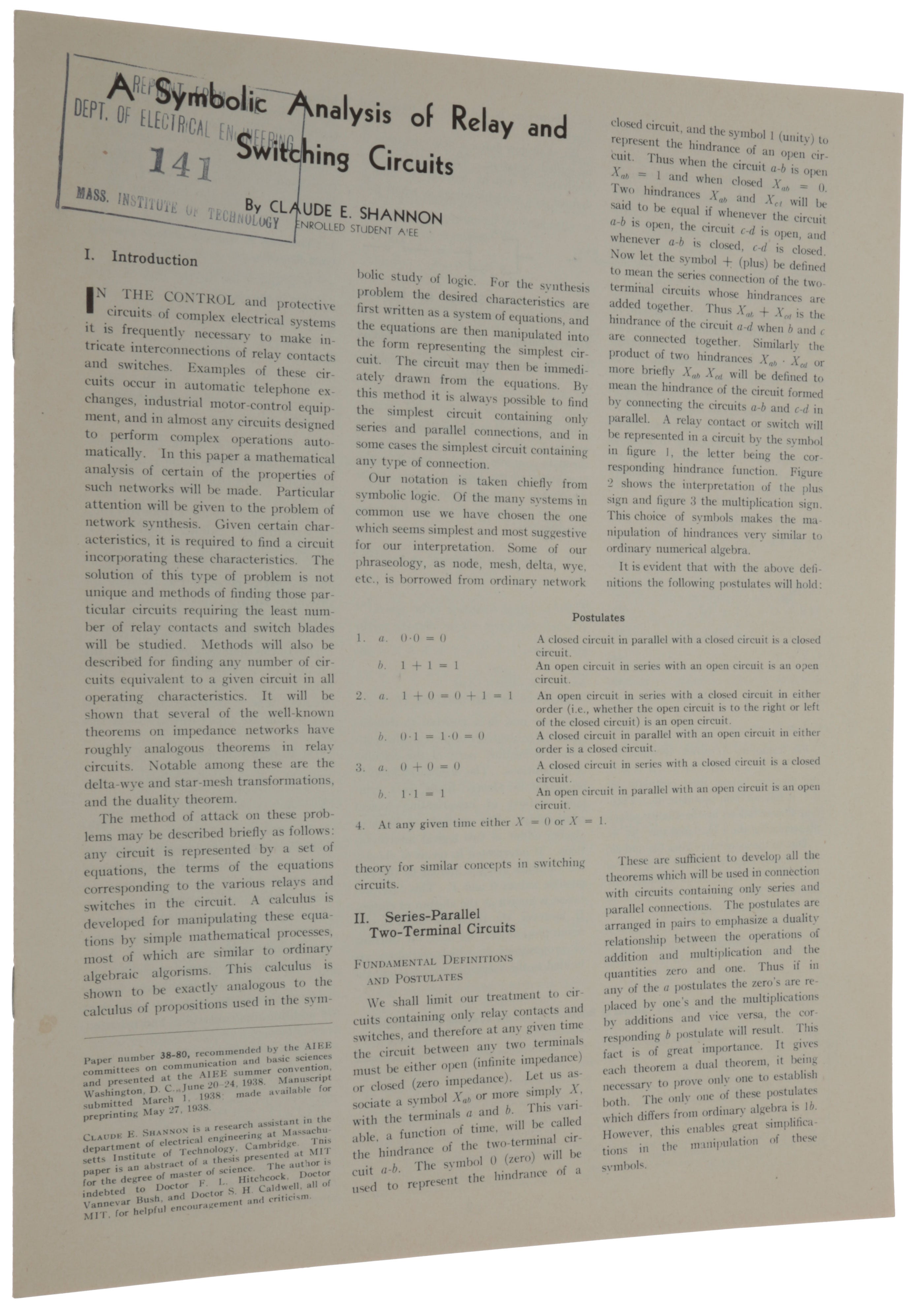
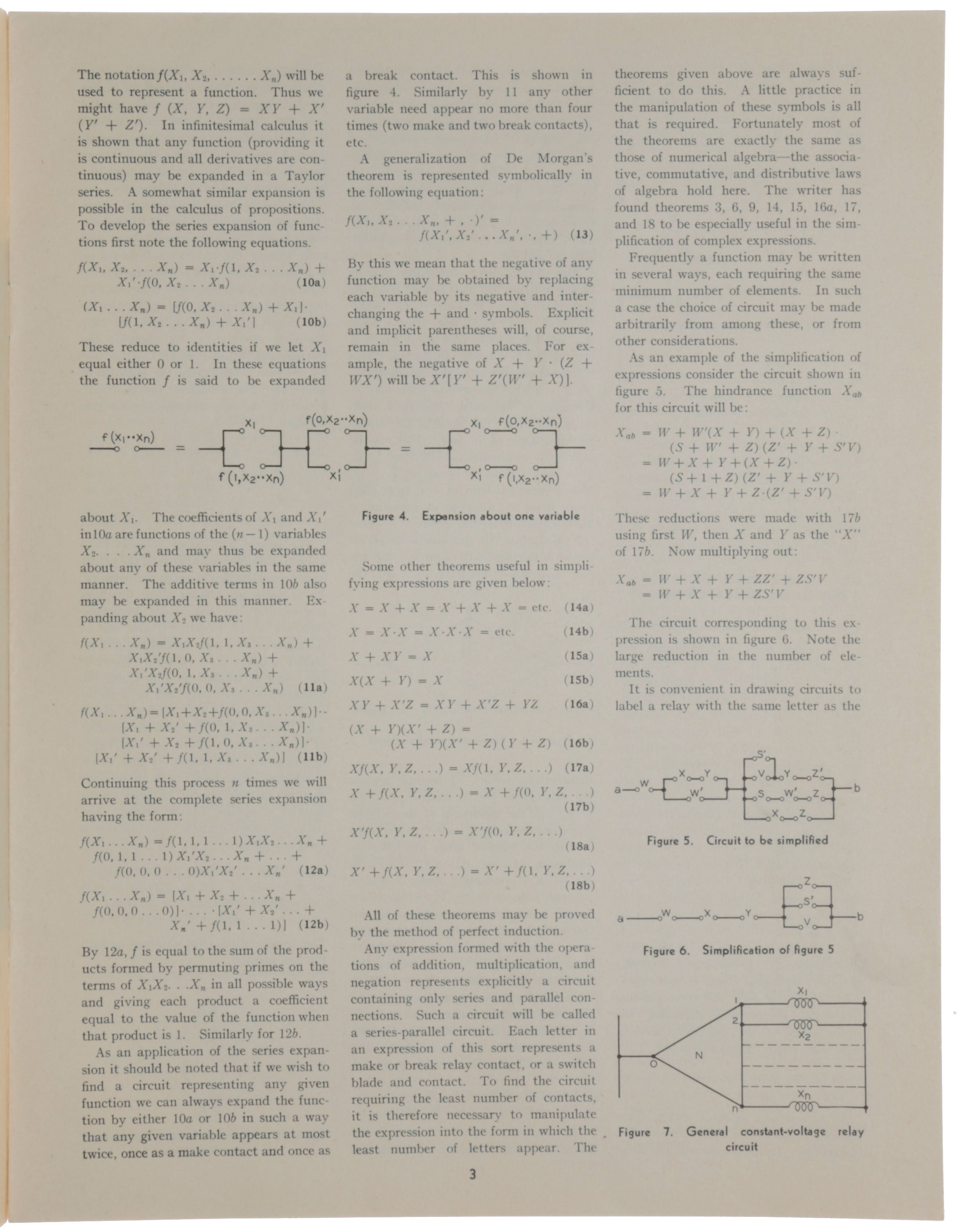
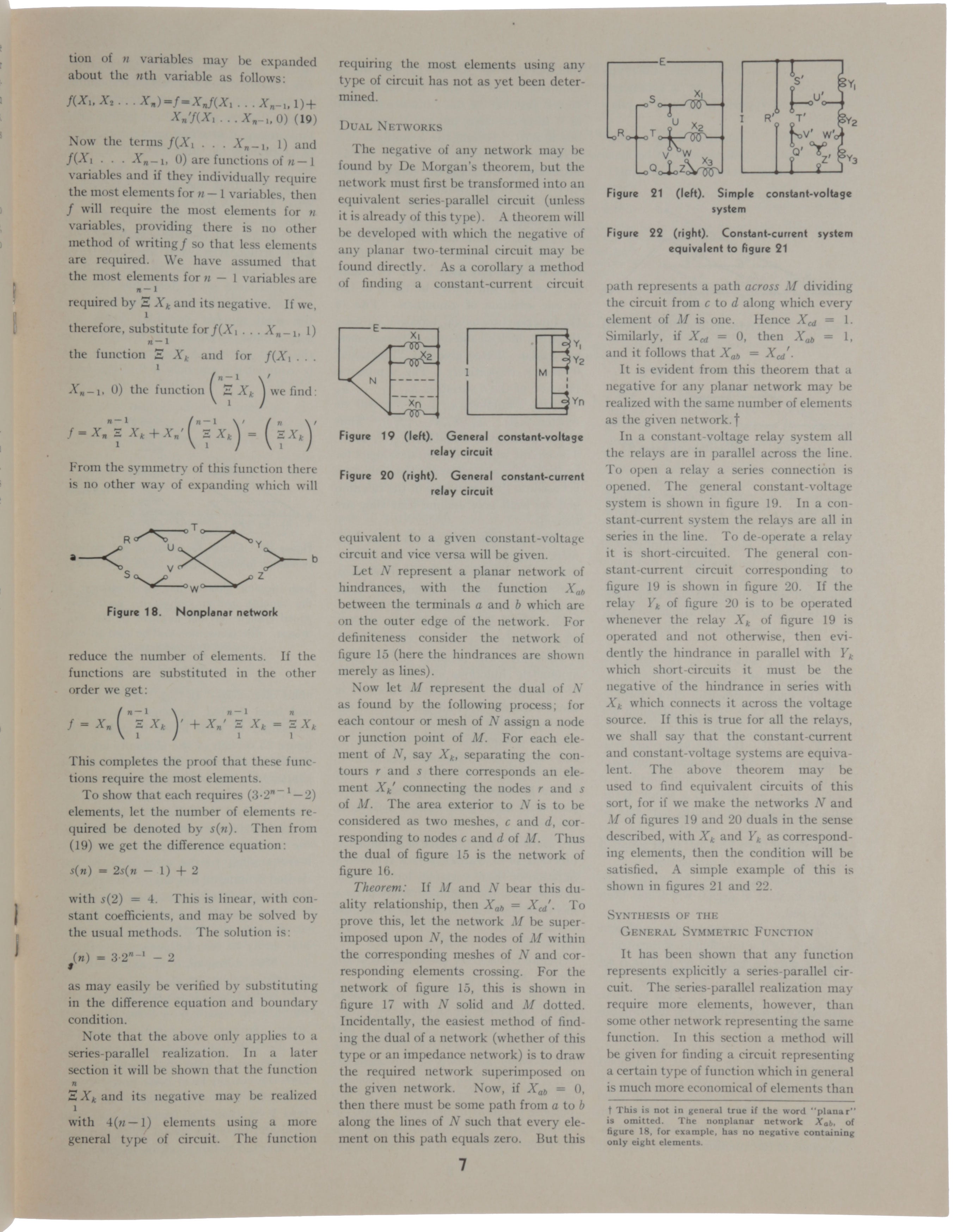
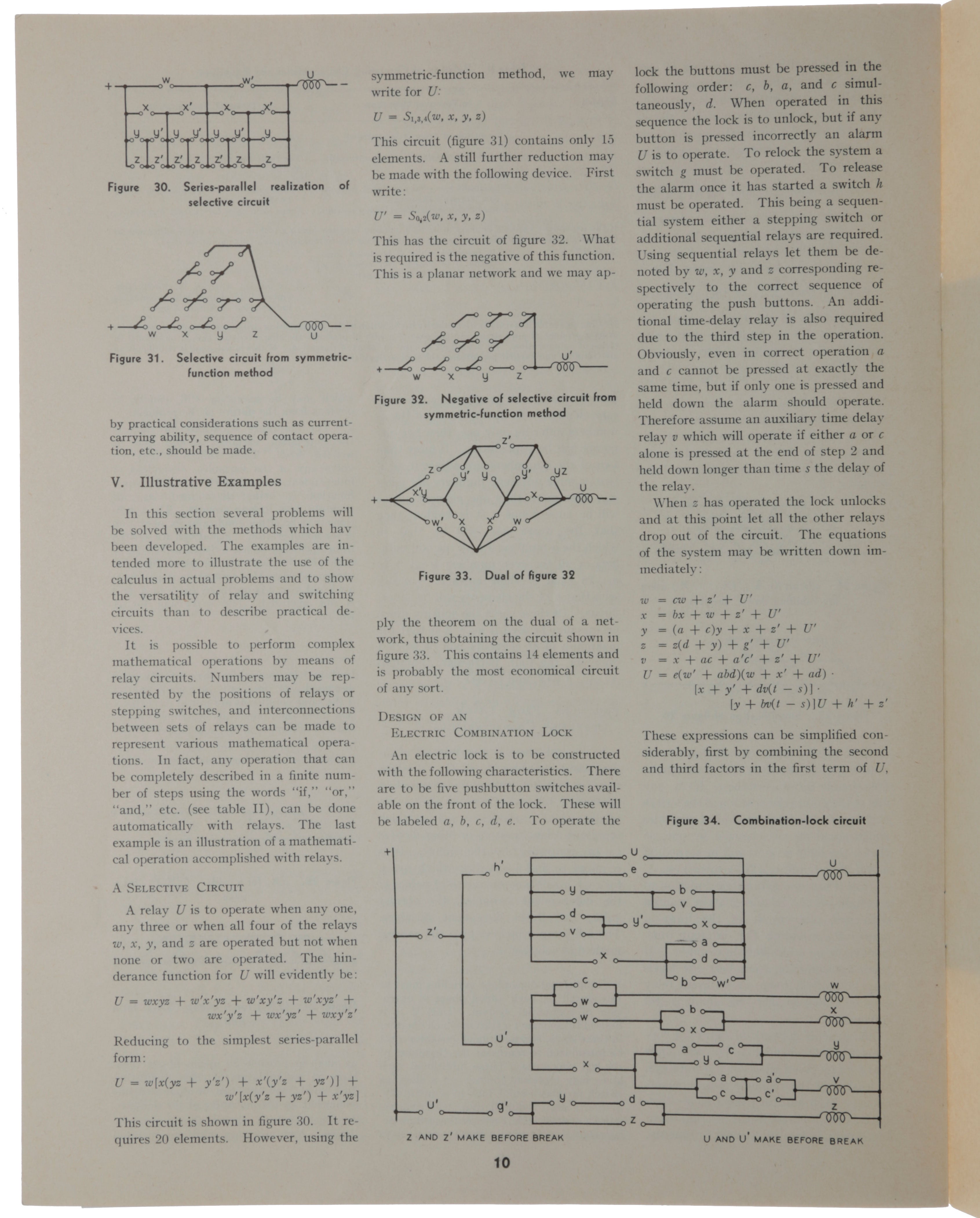
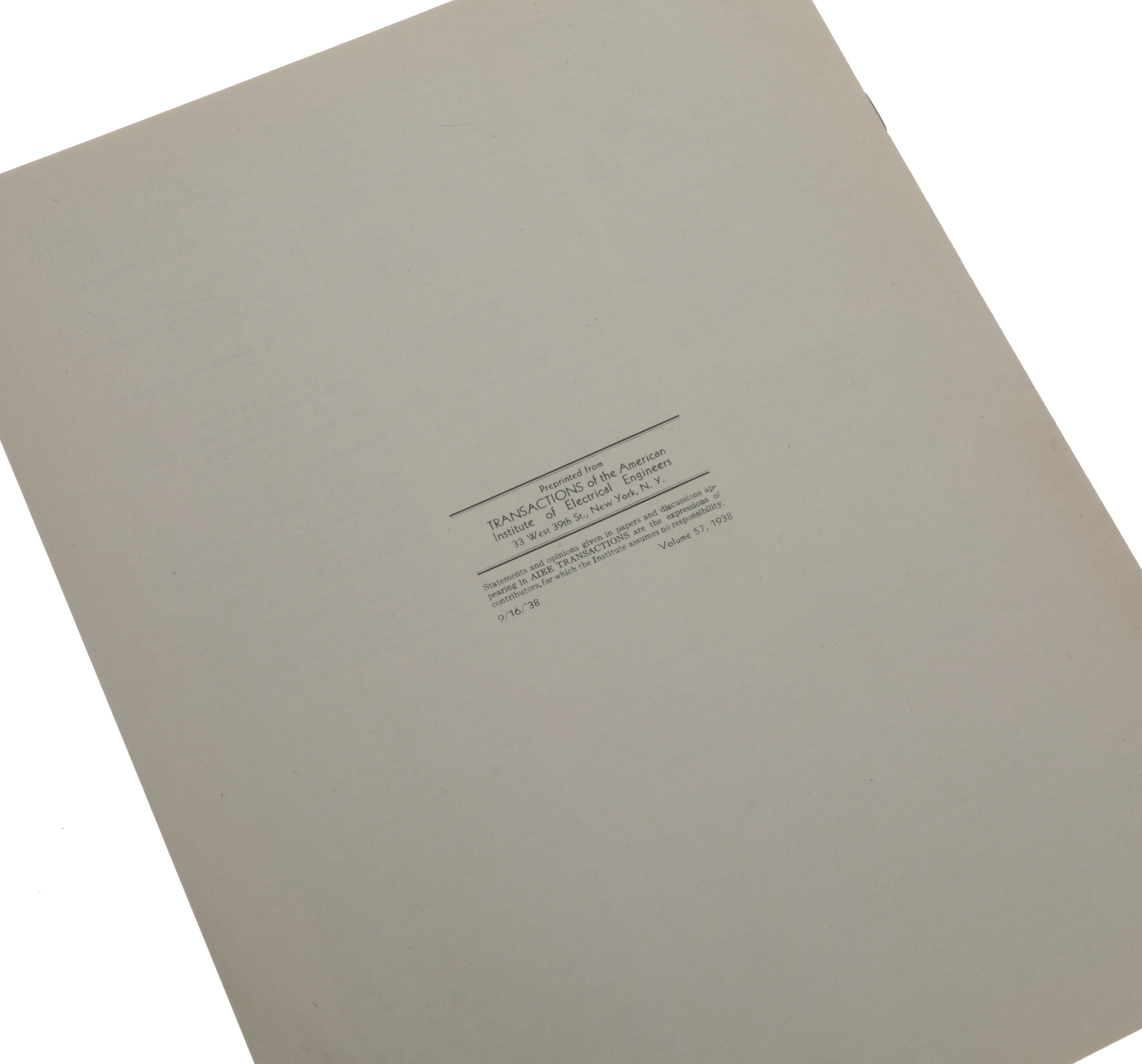
New York: American Institute of Electrical Engineers [AIEE], 1938. First edition, in the form Shannon’s own department circulated three months before the bound journal reached its subscribers, of the paper that made the design of switching circuits a deductive science. In the summer of 1937 Claude Shannon, a twenty-one-year-old research assistant at MIT, was running Vannevar Bush’s differential analyser — a room-sized analog computer whose motions were governed by a control circuit of about a hundred relays — when he saw that the open-and-closed behaviour of those relays mapped exactly onto the true-and-false of Boolean logic. The observation looked elementary; its consequence was that the design of switching networks could be lifted out of intuitive cut-and-try and carried out within a rigorous algebra. He worked it up over that summer at Bell Telephone Laboratories and over the following year as his MIT master’s thesis. The paper appeared in 1938 in three closely related forms; the present item is the second of them — the typeset offprint the American Institute of Electrical Engineers supplied to MIT’s Electrical Engineering Department on 16 September 1938 for redistribution within the department, three months ahead of the bound Transactions. In its eleven typeset pages the paper opens with four postulates now found in some form in every text on switching theory: 0·0 = 0; 1 + 1 = 1; 1 + 0 = 0 + 1 = 1; 0·1 = 1·0 = 0; and ‘at any given time either X = 0 or X = 1’. From these, with a single convention — Xab the hindrance between terminals a and b, 0 the closed circuit and 1 the open one — Shannon builds, across thirty-six figures, a complete calculus for relay networks: the canonical series-parallel form, the expansion of a switching function in any subset of its variables, the equivalence transformations, the duality theorem for planar networks, and the realisation of symmetric functions. The paper’s fifth section then turns the calculus to engineering, in five worked examples: a selective relay that responds to one, three, or four of its inputs but not to two; an electric combination lock that opens only to its buttons pressed in the right order; a vote-counter; a base-translator; and — the example for which the paper is most remembered — a binary full-adder, the first published electrical circuit derived from a symbolic-Boolean framework, and the schematic germ of every digital computer that followed. What gave the algebra its force was economy as much as rigour. Shannon framed the problem in his opening sentence as that of the automatic telephone exchange, and set two explicit goals: to find, for a required behaviour, a circuit equivalent to any other that realised it, and to find the one needing the fewest relay contacts. The second answered to the largest engineering enterprise of the age. A telephone exchange was a machine built almost wholly of relays — by mid-century a single automatic exchange might operate more than a thousand of them to set up one call, and the Bell System counted its relays in the hundreds of millions — so that a method for proving two contact networks equivalent, and for choosing the leaner, turned every contact saved into a cost not paid across tens of thousands of installations. The algebra gave the exchange engineer, for the first time, a way to prove a circuit minimal rather than merely workable. The paper exists in three states, each in a different physical form. The earliest is the AIEE Advance Copy preprint of June 1938, twenty-eight typewritten quarto leaves with Shannon’s thirty-six figures drawn by hand, distributed to delegates of the Summer Convention; the latest is the bound Transactions volume 57 of December 1938, the normal journal channel. The present copy is the state between the two: a properly typeset offprint, pulled from the same plates as the bound journal — the verso carries the AIEE’s ‘Preprinted from TRANSACTIONS’ legend and the dated stamp 9/16/38 — which the AIEE supplied to MIT’s Electrical Engineering Department for departmental redistribution. To each copy the department added, in the upper-left of the front recto, a hand-stamped black-ink rectangle reading ‘A Reprint from the Dept. of Electrical Engineering 141 Mass. Institute of Technology’, set partly over Shannon’s title and byline. The embedded numeral is most naturally read as a control number in a running departmental redistribution series; it is not, as is sometimes supposed, a street address — MIT has stood at 77 Massachusetts Avenue since 1916. The September date falls at the opening of the autumn term, when the department would have put the paper into the hands of its faculty and graduate students. Below the byline the paper prints the credential ‘Enrolled Student A.I.E.E.’ — the grade Shannon held in 1938 as a registered MIT graduate student, his master’s and doctorate not formally conferred until 1940. For the paper he was given the Alfred Noble Prize of 1939, awarded by the American engineering societies for the best paper by an author under thirty; it was the only formal recognition the work drew in its own decade, before the field it founded — the whole of digital logic design — had grown large enough to recognise it from within. Shannon kept a small number of these September offprints in his own files, and the present copy is one of them, unmarked but for the departmental stamp — at once a record of how Shannon’s own department received the paper and of how Shannon himself preserved it. About eight copies of the September printing are now known, all from his personal files; not one has been located in an institutional collection, and the printing carries no record on WorldCat. A single copy has appeared at auction, at Christie’s in December 2023, its price undisclosed. For a paper of this consequence the survival is strikingly narrow. The discipline that grew from these pages took Shannon’s minimisation problem as its founding question. Edward McCluskey, working from Shannon’s calculus, devised the first algorithm for reducing a switching function to its simplest form — the procedure now taught to every engineering student as the Quine–McCluskey method — and set the new field down in Introduction to the Theory of Switching Circuits (1965), the textbook from which logic design became a subject in its own right. What Shannon had proposed as a way to spare relay contacts in a telephone exchange had become the formal grammar of digital hardware. Herman Goldstine, surveying the field from Princeton in The Computer from Pascal to von Neumann (1972), called Shannon’s master’s thesis ‘surely one of the most important master’s theses ever written … a landmark in that it helped to change digital circuit design from an art to a science’. This offprint is the form in which Shannon’s own department first held that change in its hands, three months before the wider profession saw it: Boolean algebra and the design of switching circuits, set down in eleven typeset pages, with the digital age following from them. Offprint preprinted from Transactions of the American Institute of Electrical Engineers, vol. 57 (1938). 4to (280 × 215 mm), pp. [1]–11, [12 blank], in original printed self-wrappers; thirty-six figures printed as line-engravings integrated into the text columns; stapled at the spine fold. Hand-applied black-ink Department of Electrical Engineering redistribution stamp (‘A Reprint from the Dept. of Electrical Engineering 141 Mass. Institute of Technology’) in the upper-left of the front recto, partially overlapping the title and byline. AIEE editorial-responsibility disclaimer and the imprint ‘Preprinted from TRANSACTIONS of the American Institute of Electrical Engineers / 33 West 39th St., New York, N.Y. / Volume 57, 1938 / 9/16/38’ printed on the verso of the rear leaf. Provenance: from the personal files of Claude E. Shannon; unmarked apart from the institutional redistribution stamp.
Item #5553
Price: $95,000.00
