
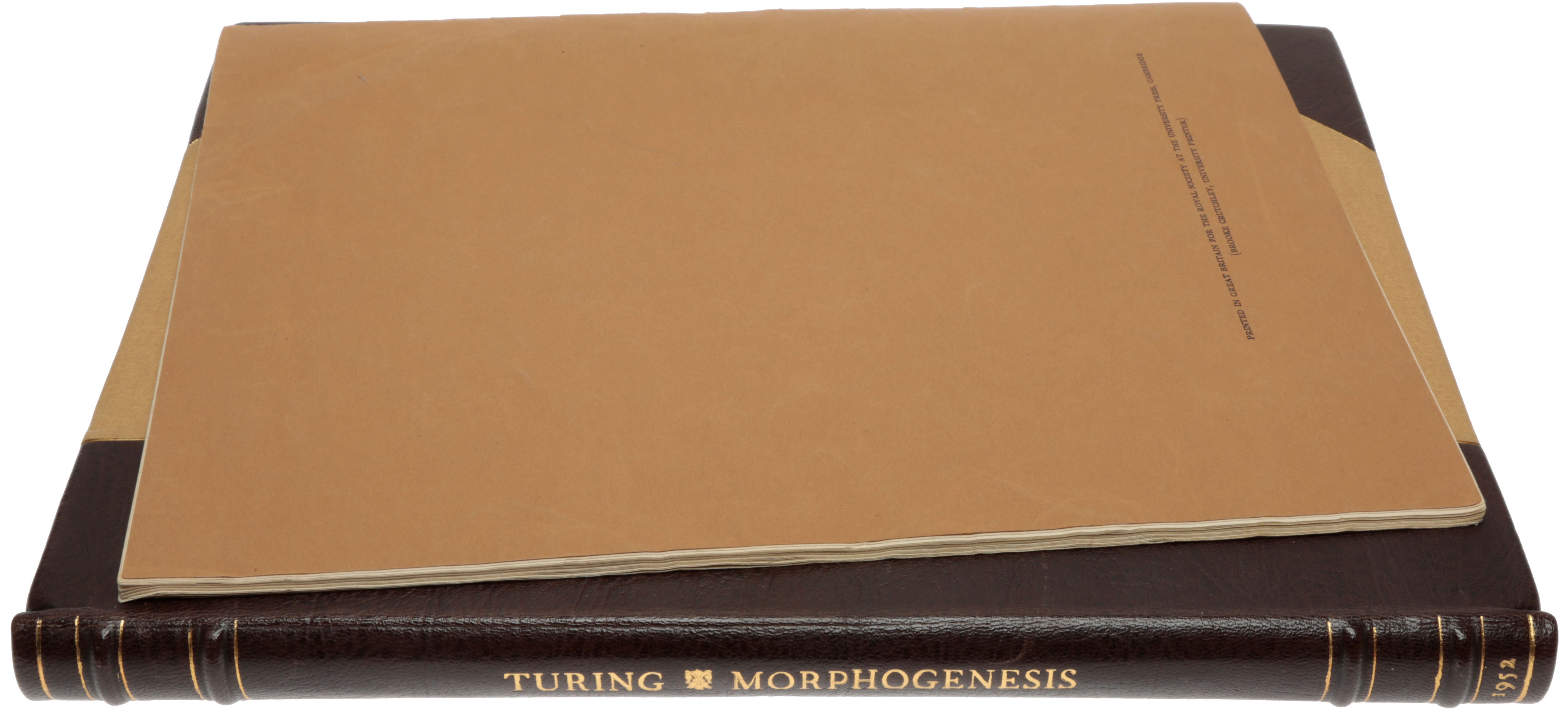
The Chemical Basis of Morphogenesis.
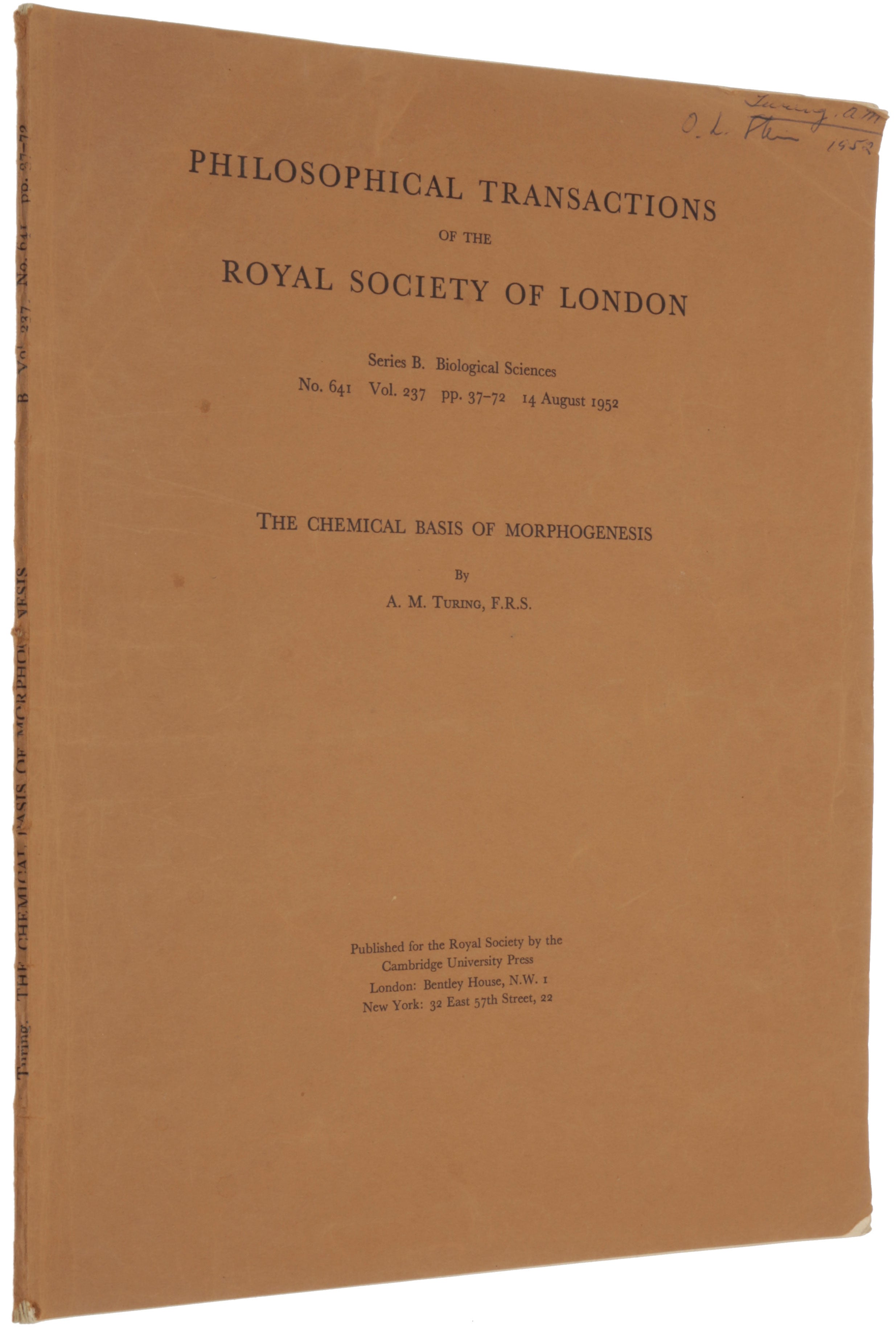
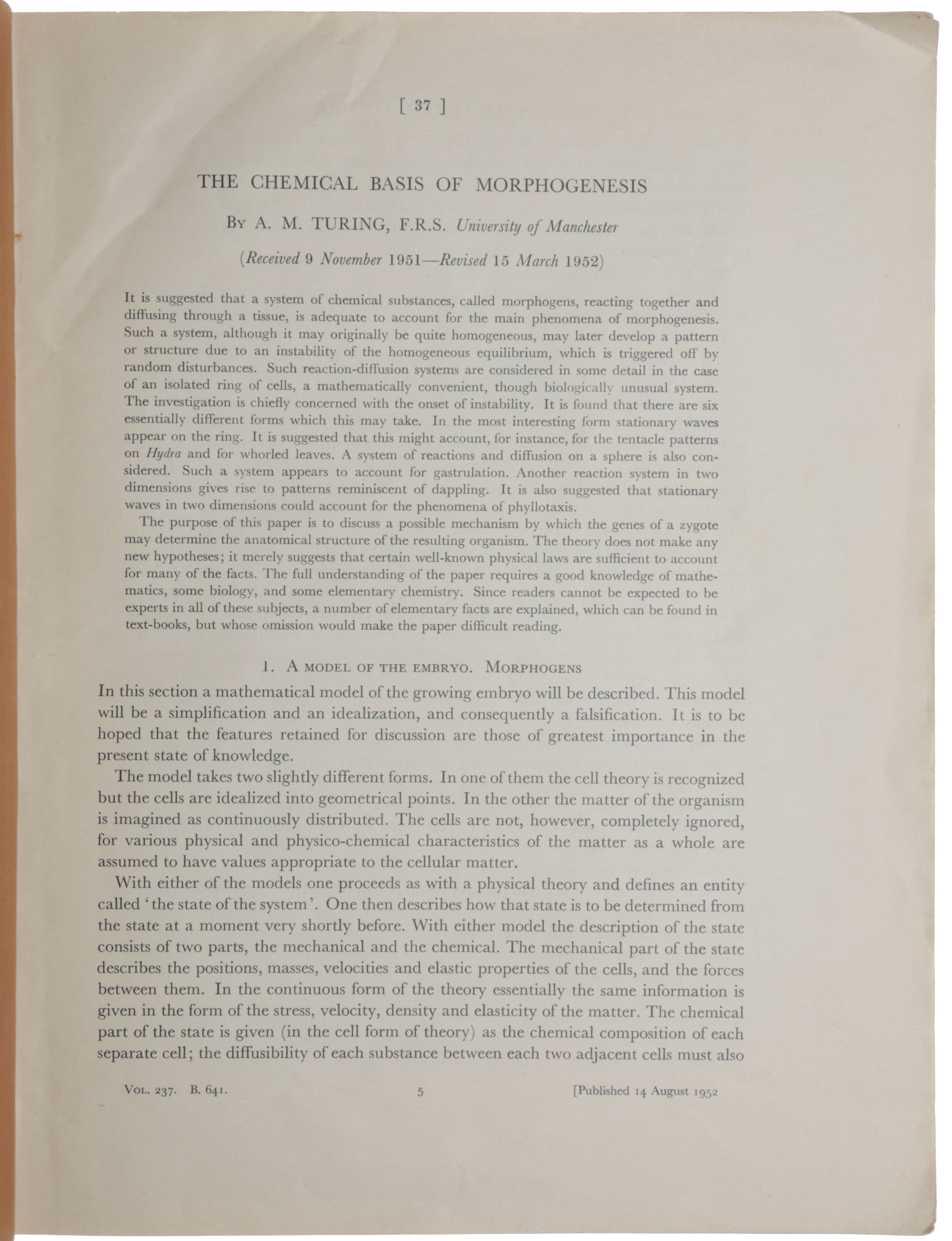
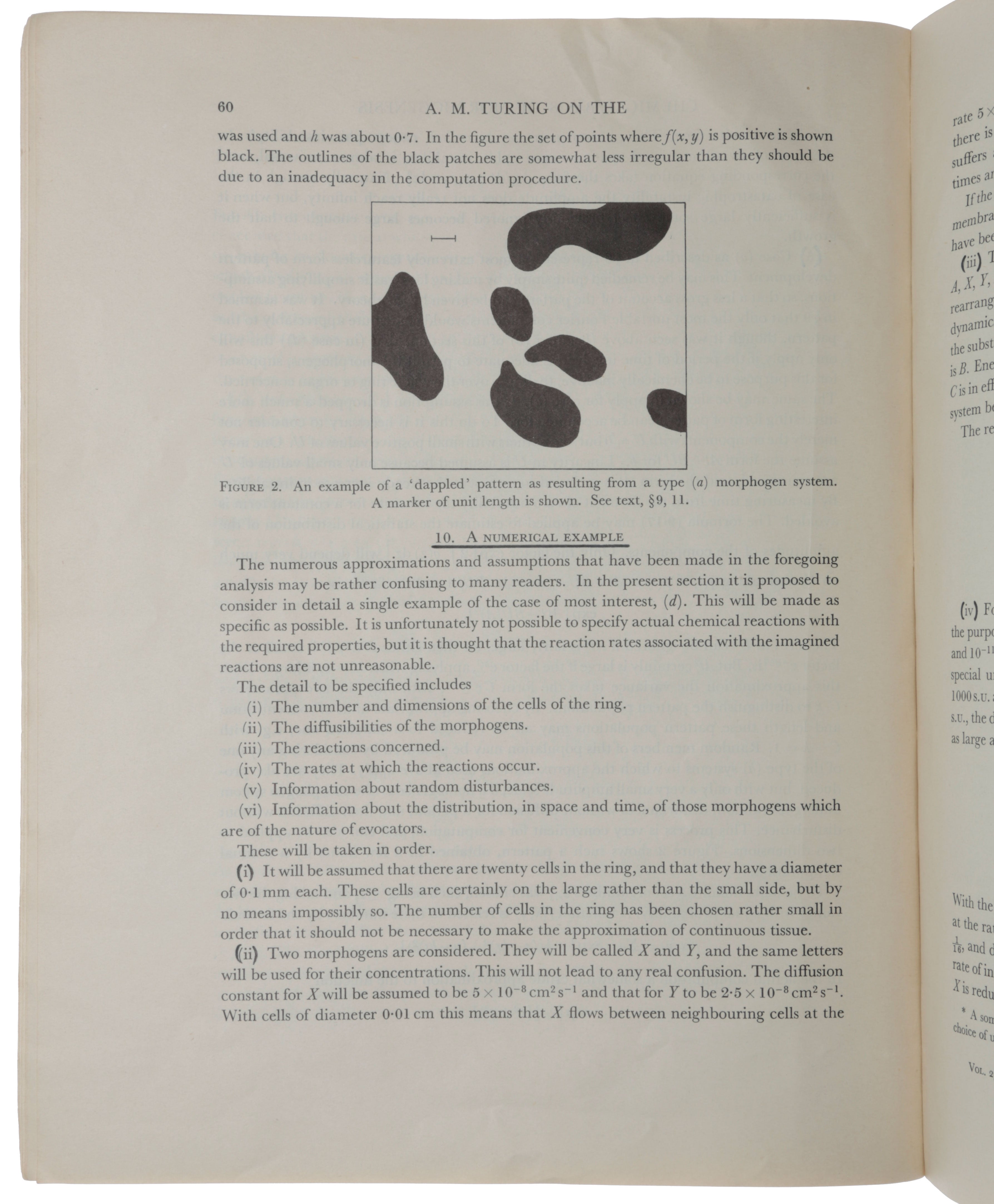
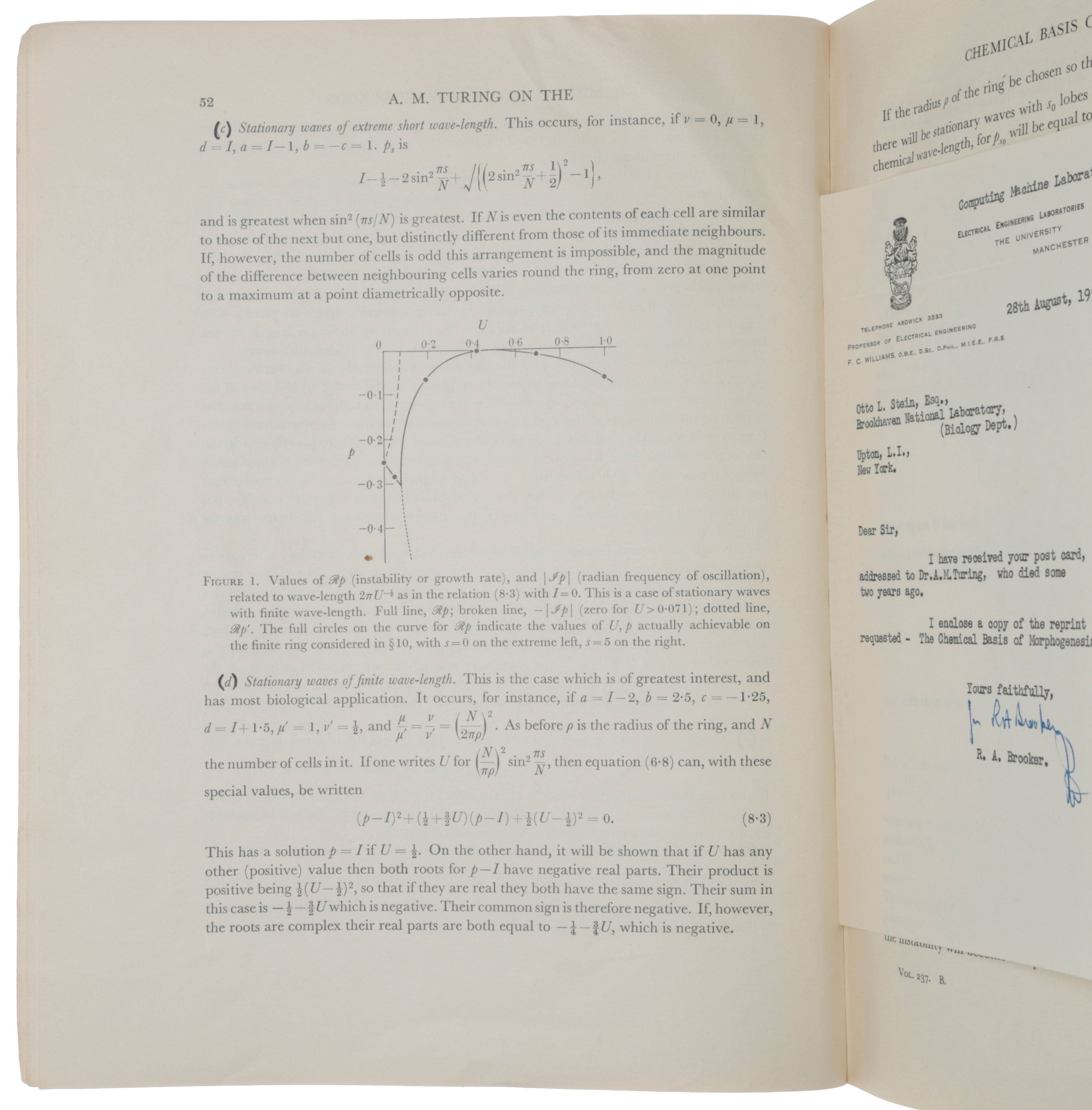
London: Cambridge University Press for the Royal Society, [1952]. First edition of the rare true author’s-presentation offprint of Turing’s last major published work — the paper in which he showed how chemical diffusion through living tissue can break symmetry and organise itself into stable spatial pattern, founding the mathematical theory of biological pattern formation and standing now, of everything Turing wrote, as the most-cited. The present copy is the author’s own presentation issue, and it carries an exceptional association: the ink ownership inscription of the plant morphologist Otto L. Stein, and, loosely inserted, a typed letter of 28 August 1956 from R. A. Brooker — Turing’s successor at the Manchester Computing Machine Laboratory — answering the request for a reprint that Stein had posted, more than two years earlier, to Turing himself. Turing came to Manchester in 1948 as deputy director of the Royal Society Computing Machine Laboratory, and when the Ferranti Mark I was delivered there in February 1951 he had at last the machine on which to attack a question that had held him since he read D’Arcy Wentworth Thompson’s On Growth and Form as a young man: how does biological matter, growing from a nearly uniform egg, decide where to put a limb, a stripe, a whorl of leaves? He told Mike Woodger at the National Physical Laboratory that one of the machine’s first jobs would be ‘to do something about “chemical embryology”’ (Hodges, Alan Turing: The Enigma, p. 436), and worked at it through 1951, often at night. He told Robin Gandy the theory was meant ‘to defeat the Argument from Design’: where the biology of the day spoke vaguely of ‘morphogenetic fields’ endowing tissue with an invisible pattern, and where Michael Polanyi held that embryonic form admitted no mechanical explanation at all, Turing proposed to treat the field as nothing more than a distribution of chemical concentrations and to ask what such a distribution could do on its own. His answer is the paper’s lasting contribution. Pattern, he showed, can arise from the interaction of diffusing, reacting chemical substances — he called them morphogens — by a mechanism that runs flatly against intuition. Diffusion alone smooths differences away and should erase any pattern; but Turing proved that in a system of two such substances reacting together, one diffusing faster than the other, the uniform state becomes unstable, so that the smallest random disturbance grows into a fixed, regular spatial pattern of concentration. He worked the case through on a ring of cells, classified the kinds of instability that can result, and computed a worked example by hand with the Ferranti’s help — the ‘dappled’ figure on the paper’s sixtieth page has since become the visual emblem of the whole field. The closing pages name the targets: the tentacles of Hydra, the whorl of leaves on a stem, the breaking of symmetry at gastrulation, the spots on an animal’s coat, the Fibonacci spirals of a fir-cone. The mechanism — diffusion, the great smoother, made the engine of pattern — is what the world now calls the Turing instability, and its patterns Turing patterns. The paper appears in two forms, told apart by a single detail. The author’s presentation offprint — the present copy — carries no price on its wrapper; the commercial reprint that Cambridge University Press sold to recover costs prints ‘Price Eight Shillings’ at the foot of the wrapper and of the first leaf. The Royal Society gave its authors about a hundred free offprints, so the presentation issue was always scarce, and surviving copies are rare in the trade. Institutional copies of the presentation issue are few: the Turing Archive at King’s College Cambridge holds one, catalogued AMT/B/22, and a copy of the paper is reported in the Max Newman collection at Bletchley Park, though whether that copy is the presentation issue or the priced reprint is not documented. The benchmark at auction is the copy of Turing’s wartime collaborator Donald Bayley, £12,800 at Bonhams in November 2023; a further presentation offprint, from the gift Turing’s mother made to his friend Norman Routledge, brought £19,500 at Rare Book Auctions in June 2025. The association is the copy’s distinction. Otto Ludwig Stein (1925–2014) was a German-born American botanist who took his doctorate at the University of Minnesota in 1954 and worked, at Brookhaven National Laboratory, on precisely the problem Turing’s paper had named — the rates at which leaves are initiated at a growing shoot-tip, the phyllotaxis Turing had singled out as a target. He came to Turing’s theory through the Manchester botanist C. W. Wardlaw, who had worked with Turing on an unpublished joint paper on plant morphogenesis — the typescript survives in the King’s College Turing Archive — and who carried the theory to botanists in two New Phytologist commentaries of 1953 and 1955. Stein duly wrote to Turing for a copy of the paper — but his postcard reached Manchester after Turing’s death at Wilmslow on 7 June 1954, and lay unanswered until R. A. (‘Tony’) Brooker, whom Turing had brought to Manchester to take over the running of the Ferranti, replied for the dead man. Brooker’s letter, typed on the printed laboratory stationery of F. C. Williams — whose honours as printed date it to the 1950s — is plain and exact: he has received the postcard ‘addressed to Dr. A. M. Turing, who died some two years ago’, and encloses ‘a copy of the reprint requested’. It is a slight document with a long reach: a working botanist’s request for the paper, the author two years dead, answered out of the laboratory’s reserve by the man who had inherited his desk — and it ties this copy directly to the work the paper had set in motion. For two decades the paper was largely passed over. The biologists who noticed it were sceptical — Conrad Waddington thought the mechanism too chancy to yield the reliable forms of real development — and the discovery of the structure of DNA in 1953 turned the field toward the gene. Then in 1972 Alfred Gierer and Hans Meinhardt, working on the freshwater Hydra, derived Turing’s mechanism over again without knowing of him, alerted to the 1952 paper only by a referee; their activator-inhibitor model became the working form of the theory. From the 1980s it came into its own. James D. Murray made it the mathematics of animal markings; the first Turing pattern was produced in a laboratory chemical reaction in 1990; and in 1995 Shigeru Kondo showed that the stripes of the marine angelfish rearrange themselves as the fish grows — new stripes inserted and old ones splitting rather than the existing bands simply stretching, the moving signature of a reaction-diffusion wave rather than a fixed pre-pattern. By 2012 the spacing of the digits in a developing vertebrate limb had been traced to a Turing network of three interacting signals. What had been an unread paper of mathematical biology was now the accepted account of how living things come to be patterned. And then it was built. In December 2024 a team at Imperial College led by Jure Tica reported the first synthetic gene circuit — three interacting genes engineered into living Escherichia coli — that produces, on the theory’s own terms, the stationary stripes Turing’s analysis had predicted, seventy-two years after he posted the manuscript to the Royal Society. The leopard, as James D. Murray had put it in How the Leopard Gets Its Spots (1988), got its spots; what the new work adds is that bacteria can now be engineered to grow them to order — the Turing pattern no longer only found in nature but made in the laboratory to Turing’s own design. References: B. J. Copeland (ed.), The Essential Turing, Clarendon Press, 2004 (‘in every respect ahead of its time’, p. 510) — Andrew Hodges, Alan Turing: The Enigma, Burnett Books, 1983 — P. T. Saunders (ed.), Morphogenesis (volume 3 of Collected Works of A. M. Turing), North-Holland / Elsevier, 1992 — Philip K. Maini and Thomas E. Woolley, ‘The Turing Model for Biological Pattern Formation’, in S. Barry Cooper and Jan van Leeuwen (eds.), Alan Turing — His Work and Impact, Elsevier, 2013, pp. 684–693 — Alfred Gierer and Hans Meinhardt, ‘A theory of biological pattern formation’, Kybernetik 12 (1972), pp. 30–39 — Shigeru Kondo and Rihito Asai, ‘A reaction–diffusion wave on the skin of the marine angelfish Pomacanthus’, Nature 376 (1995), pp. 765–768 — Jure Tica et al., ‘A three-node Turing gene circuit forms periodic spatial patterns in bacteria’, Cell Systems 15 (December 2024), pp. 1123–1132. Offprint from Philosophical Transactions of the Royal Society of London, Series B, Biological Sciences, vol. 237, no. 641 (14 August 1952). Large 4to (302 × 233 mm), pp. [4], 37–72, [2 blank], with two text-figures (stationary waves p. 52; the ‘dappled’ pattern p. 60), in the original light brown printed wrappers without the ‘Price Eight Shillings’ line on either the front wrapper or the first leaf of text — the feature distinguishing the true author’s presentation offprint from the priced commercial issue. Light wear to extremities, otherwise fine and unrestored. Ink ownership inscription of Otto L. Stein at the upper right corner of the front wrapper; light pencil annotations to a few interior pages, most plausibly in Stein’s hand. Loosely inserted: a single-sheet typed letter signed ‘R. A. Brooker’, dated 28 August 1956, on the printed Computing Machine Laboratory letterhead of F. C. Williams F.R.S., addressed to Otto L. Stein at the Brookhaven National Laboratory Biology Department, acknowledging Stein’s postcard ‘addressed to Dr. A. M. Turing, who died some two years ago’ and enclosing the present paper. Housed in a modern dark brown morocco-backed slipcase lettered in gilt ‘TURING — MORPHOGENESIS — 1952’.
Item #5612
Price: $25,000.00
